Multiple dental implants can replace several missing teeth and help restore your ability to chew comfortably and smile with confidence. Missing several teeth can affect more than the appearance of your smile. You may find it harder to chew certain foods, feel less comfortable speaking, or notice that gaps make you self-conscious. Over time, missing teeth can also affect the way your remaining teeth fit together.
If you are exploring ways to replace multiple missing teeth, dental implants may offer a stable, long-term option. Depending on how many teeth are missing and where the gaps are located, implants can support individual crowns, an implant-supported bridge, or a full-arch restoration.
At Chatham Dental Arts in Chatham, NJ, treatment planning begins with understanding your oral health, the condition of your jawbone, and your goals for restoring your smile. Learning how multiple dental implants work can help you prepare for a conversation with your dentist about the options available to you.
How Multiple Dental Implants Replace Missing Teeth
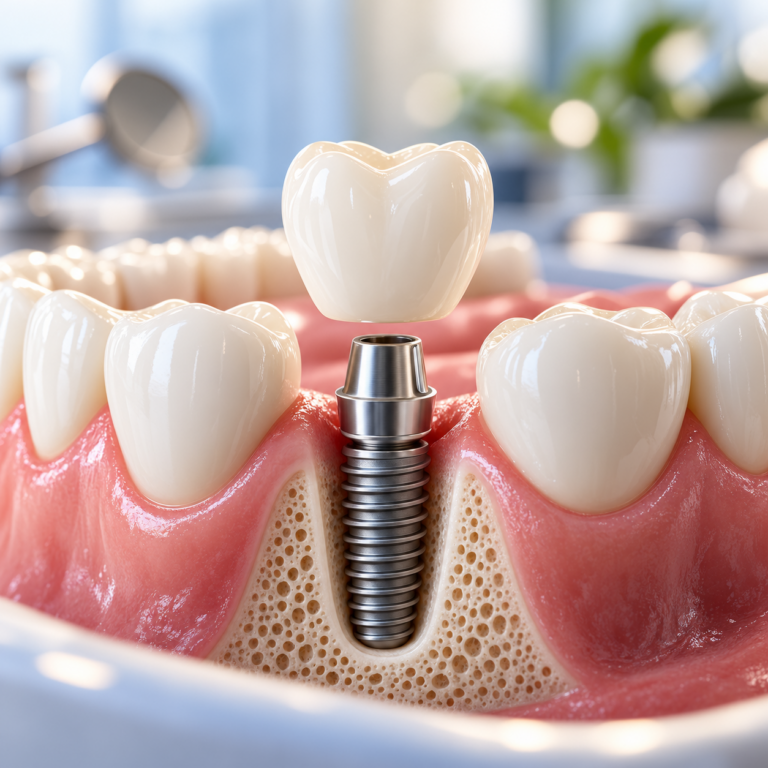
Dental implants are small posts, commonly made from titanium, that a dental professional places in the jawbone to serve as artificial tooth roots. Over time, the bone can integrate with the implant, creating a foundation for a replacement tooth or a larger dental restoration.
When several teeth are missing, your dentist can plan implant treatment around the number and location of the gaps. Importantly, replacing several missing teeth does not always require placing one implant for every tooth.
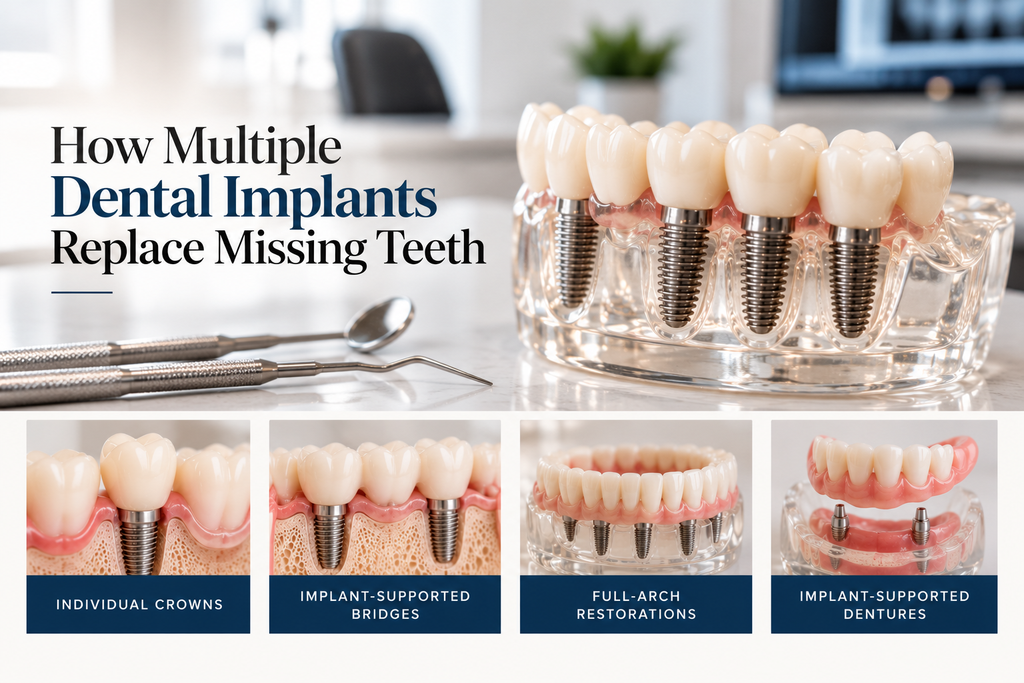
Depending on your circumstances, multiple dental implants may support:
- Individual crowns: Separate implants support individual replacement teeth.
- Implant-supported bridges: Two or more implants support a bridge that replaces several missing teeth.
- Full-arch restorations: Strategically placed implants support a complete row of replacement teeth.
- Implant-supported dentures: Implants help stabilize a removable denture.
The most appropriate option depends on your dental anatomy, the condition of your remaining teeth, your bone volume, your bite, and your preferences.
What Happens When You Lose Multiple Teeth Without Replacement?
Losing several teeth can affect everyday activities in ways you may not immediately expect.
Difficulty Chewing Comfortably
Missing teeth can make it harder to break down certain foods. Depending on which teeth are missing, you may begin favoring one side of your mouth or avoiding foods that require more chewing.
A well-planned tooth replacement can help restore chewing function, although the result depends on the type of restoration and your individual circumstances.
Changes in Your Bite
Your teeth work together when you bite and chew. When several teeth are missing, the distribution of biting forces may change. Remaining teeth may also shift into available spaces in some cases.
Replacing missing teeth can help restore a more functional bite, but your dentist must evaluate the position of your remaining teeth and how your upper and lower teeth meet before recommending treatment.
Changes in Appearance
Gaps in your smile may affect your confidence, particularly when the missing teeth are visible when you speak or smile.
Tooth loss can also contribute to changes in the underlying jawbone over time. When you lose a tooth, the bone in that area receives less stimulation from chewing because the natural tooth root no longer supports it. The amount of bone change varies between individuals.
Concerns About Long-Term Oral Health
Gaps caused by missing teeth can make maintaining a balanced bite more difficult. The remaining teeth and surrounding tissues also continue to require regular care.
Replacing missing teeth is not always necessary with the same treatment for every patient. A dental examination helps determine whether replacement is advisable and which approach best supports your oral health and daily function.
How Many Dental Implants Do You Need for Multiple Missing Teeth?
There is no single number of implants that works for every patient. Your dentist determines the number of implants based on how many teeth need replacement, their location, the quality and amount of available bone, and the type of restoration you need.
Replacing Several Teeth in a Row
If you are missing several neighboring teeth, an implant-supported bridge may be an option.
Instead of placing an individual implant for every missing tooth, your dentist may be able to use strategically positioned implants to support a bridge containing multiple replacement teeth.
For example, your dentist may use two implants to support a bridge that replaces three adjacent teeth. However, this is not suitable for every patient. The span of the bridge, biting forces, implant positions, and bone support all influence the treatment plan.
Replacing Teeth in Different Areas
If healthy natural teeth separate the gaps, your dentist may recommend individual implants, separate implant-supported restorations, or a combination of treatments.
The goal is to replace the missing teeth while considering the health and position of the surrounding teeth.
Replacing an Entire Upper or Lower Arch
If you are missing most or all the teeth in your upper or lower jaw, a full-arch implant restoration may be worth discussing.
In selected cases, a fixed bridge can attach to a strategically planned number of implants. Some full-arch systems use four implants, while others use more. The appropriate number depends on your anatomy, bone support, restoration design, and clinical needs.
Your dentist must evaluate your mouth before determining whether a full-arch approach is suitable.
Options for Replacing Missing Teeth With Multiple Dental Implants
Several treatment options can replace multiple missing teeth. Each has different advantages, limitations, and maintenance requirements.
1. Individual Dental Implants
An individual dental implant can support a crown that replaces one missing tooth. If you have multiple missing teeth in separate locations, your dentist may recommend individual implants where appropriate.
This approach can replace teeth without relying on neighboring natural teeth for support, as a traditional tooth-supported bridge would.
However, each implant requires adequate planning and suitable conditions for placement. Individual implants may not be the most practical option for every pattern of tooth loss.
2. Implant-Supported Bridges
An implant-supported bridge uses implants to support several replacement teeth connected as one restoration.
This option may be suitable when multiple neighboring teeth are missing. Because the bridge can span a gap, it may reduce the number of implants needed compared with replacing every missing tooth individually.
The dentist must evaluate the length of the span, the location of the implants, your bite, and the forces the restoration will experience during chewing.
3. Implant-Supported Dentures
Implant-supported dentures use dental implants to improve the stability of a denture.
Some designs allow you to remove the denture for cleaning, while other full-arch restorations remain fixed in place and require professional maintenance.
Implant-supported dentures may be worth considering if you are missing many teeth and want greater stability than a conventional removable denture provides.
The number of implants and the attachment system depend on the design of the denture and your clinical needs.
4. Full-Arch Implant Restorations
A full-arch restoration replaces an entire row of missing teeth with a prosthesis supported by strategically placed implants.
Depending on the treatment plan, the restoration may be fixed in place or designed for removal by a dental professional or, in certain systems, by the patient.
Full-arch treatment requires careful evaluation because the dentist must consider bone volume, bite forces, gum health, cleaning access, and the long-term maintenance of the restoration.
Not everyone who is missing several teeth needs a full-arch procedure. Your dentist can explain whether a more limited restoration would meet your needs.
What Are the Benefits of Multiple Dental Implants?
When appropriately planned, multiple dental implants can offer several advantages for replacing missing teeth.
Improved Stability
Implants anchor restorations to the jawbone rather than relying entirely on neighboring natural teeth or the gums for support.
This can provide a stable foundation for individual crowns, bridges, and selected denture designs.
Support for Chewing Function
Replacing missing teeth can help restore your ability to chew more comfortably. The degree of improvement depends on the restoration, your bite, and your overall oral health.
Your dentist will evaluate how the replacement teeth should fit together to support comfortable function.
A Natural-Looking Smile
Implant-supported restorations can be designed to complement your surrounding teeth and facial features.
The final appearance depends on factors such as the position of the implants, gum contours, the restoration material, and the design of the replacement teeth.
No Dependence on Neighboring Teeth for Implant Support
An implant-supported crown or bridge receives its support from dental implants rather than from prepared neighboring natural teeth.
This differs from a traditional tooth-supported bridge, which typically requires crowns on supporting teeth. However, the best choice depends on the condition of the adjacent teeth and your overall treatment plan.
A Long-Term Tooth Replacement Option
Dental implants can function for many years when properly placed and maintained, although their longevity is not guaranteed.
The implant itself and the restoration it supports have different maintenance needs. Crowns and bridges can wear, chip, or require replacement over time, while the surrounding gums and bone need continued monitoring.
Good oral hygiene and regular dental visits remain essential after treatment.
Who Is a Candidate for Multiple Dental Implants?
Dental implants may be an option for adults who are missing several teeth and want a fixed or implant-supported replacement. However, candidacy depends on more than the number of missing teeth.
Your dentist will evaluate several factors before recommending treatment.
Jawbone Volume and Quality
Dental implants need adequate bone support. If the jawbone has lost significant volume, additional procedures such as bone grafting may be considered.
Bone grafting is not necessary for every patient. Imaging and clinical evaluation help determine whether there is sufficient bone for the planned implant positions.
Gum Health
Healthy gum tissues are important for implant treatment. Active gum disease may need to be treated before implant placement.
Patients with a history of periodontal disease may still be candidates, but they need appropriate treatment and ongoing monitoring to help protect the implants and surrounding tissues.
General Health and Medical History
Certain medical conditions, medications, and lifestyle factors can affect healing or influence treatment planning.
Tell your dentist about your medical history, medications, tobacco use, and any health concerns that could affect surgery or recovery.
Your dentist can determine whether additional precautions, medical coordination, or changes to the treatment plan are appropriate.
Oral Hygiene and Long-Term Maintenance
Implants require consistent cleaning and professional maintenance. Plaque can collect around implant restorations, potentially contributing to inflammation and damage to the supporting tissues.
Before treatment, make sure you understand how to clean your proposed restoration and how often you will need follow-up visits.
Realistic Expectations
Implant treatment involves planning, healing, and maintenance. It may take several months or longer to complete, depending on whether bone grafting, extractions, or other procedures are needed.
A consultation gives you the opportunity to discuss the expected timeline, limitations, alternatives, and responsibilities involved in maintaining the restoration.
How Does the Multiple Dental Implant Process Work?
The treatment process varies depending on the number of missing teeth, the condition of your jawbone, and the restoration being planned. In general, treatment follows several stages.
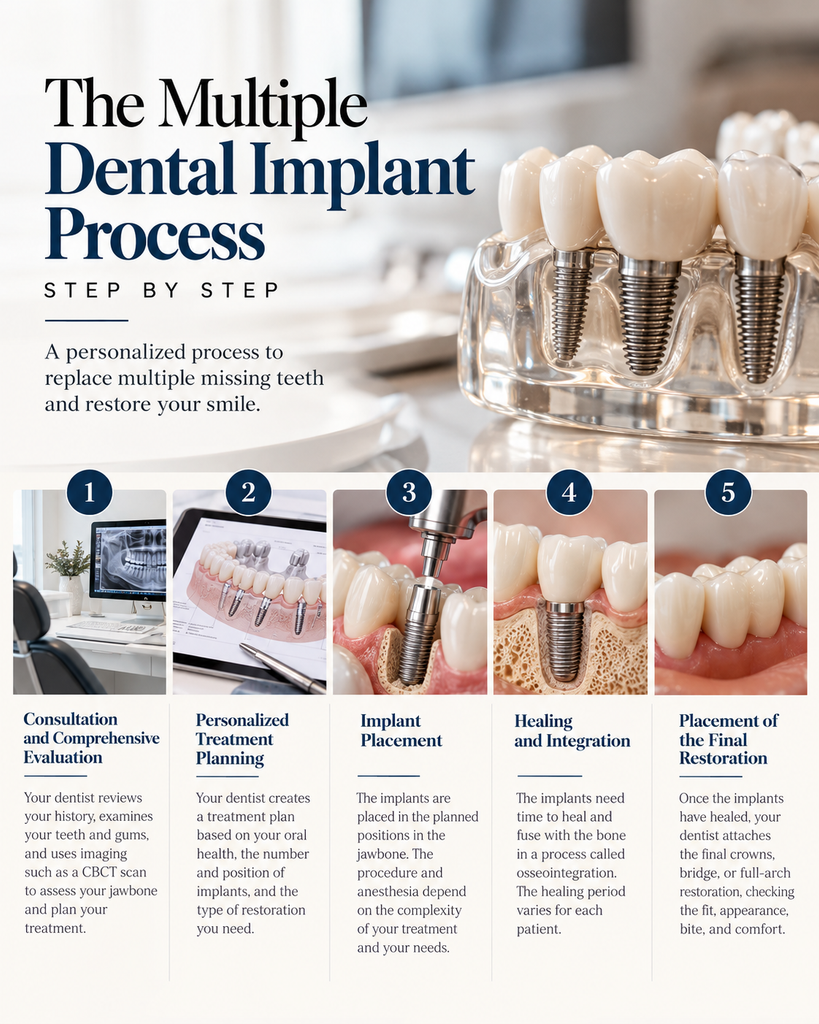
Step 1: Consultation and Comprehensive Evaluation
Your dentist reviews your dental and medical history, examines your teeth and gums, and discusses your goals for replacing missing teeth.
Diagnostic imaging may be recommended to evaluate the jawbone and surrounding structures. When appropriate, a cone-beam computed tomography scan, or CBCT, provides three-dimensional information that can help with implant planning.
Your dentist uses the findings to determine which options may be appropriate.
Step 2: Personalized Treatment Planning
After the evaluation, your dentist develops a treatment plan based on your oral health and the proposed restoration.
The plan may identify the number and position of implants, whether any teeth need extraction, whether bone grafting is advisable, and what type of replacement teeth will be used.
Your dentist should also explain the expected treatment stages, estimated healing time, maintenance needs, and alternatives.
Step 3: Implant Placement
During implant surgery, the dentist places the implants in planned positions in the jawbone.
The procedure and level of anesthesia depend on the complexity of the treatment and your needs. Your dental team will explain how to prepare for the appointment and what to expect afterward.
Some patients require additional procedures, such as bone grafting or tooth extraction, either before or during implant placement.
Step 4: Healing and Integration
After placement, the implants need time to heal and integrate with the surrounding bone. This process is called osseointegration.
The healing period varies based on the patient’s health, the location of the implants, bone quality, and whether additional procedures were performed.
Some carefully selected patients may receive temporary replacement teeth relatively soon after surgery. However, immediate or early loading is not appropriate in every case, and the dentist must determine whether it is clinically suitable.
Step 5: Placement of the Final Restoration
Once the implants have healed sufficiently and the dentist confirms that they are ready, the planned crowns, bridge, or full-arch restoration can be attached.
Your dentist checks the fit, appearance, bite, and comfort of the restoration.
Follow-up visits may be necessary to make adjustments and ensure that the restoration functions as intended.
For more information about implant treatment options, explore this guide to dental implants and tooth replacement, which explains traditional implants, implant-supported dentures, and full-arch restorations.
How Long Does Multiple Dental Implants Treatment Take?
The timeline depends on your treatment plan and how your mouth heals.
Some patients may receive implants and temporary teeth within a relatively short period. Others need several stages of treatment over a number of months.
Factors that can affect the timeline include:
- The number and location of missing teeth.
- Whether damaged teeth need extraction.
- The amount and quality of available jawbone.
- Whether bone grafting is needed.
- The type of restoration being planned.
- How well the implants integrate with the bone.
- Your overall health and healing response.
Your dentist can provide a more useful estimate after examining your mouth and reviewing any necessary imaging.
It is important not to rush the process if additional healing time is needed. The timing of each stage should support the health and stability of the final restoration.
Is Getting Multiple Dental Implants Painful?
Implant placement is typically performed with anesthesia to help manage discomfort during the procedure. The exact approach depends on the complexity of the treatment and your individual needs.
After surgery, you may experience soreness, swelling, bruising, or minor bleeding. These effects vary according to the number of implants placed and whether additional procedures were performed.
Your dental team will provide instructions for managing discomfort, caring for the surgical areas, eating during recovery, and keeping your mouth clean.
Contact your dentist if you develop worsening pain, persistent bleeding, increasing swelling, fever, or other symptoms that concern you.
Your dentist can explain what recovery is likely to involve for your specific procedure before treatment begins.
How Do You Care for Multiple Dental Implants?
Implants do not develop cavities, but the gums and bone supporting them can still be affected by plaque and inflammation. Consistent home care is therefore essential.
Clean Around the Implant Restorations Daily
Brush twice a day with a soft-bristled toothbrush and fluoride toothpaste. Clean between your teeth and around your implant restorations using the tools recommended by your dental team.
Depending on the restoration, you may benefit from interdental brushes, specialized floss, or a water flosser.
Attend Recommended Maintenance Visits
Your dentist or hygienist can examine the implant-supported restoration, assess the surrounding tissues, and check for signs of inflammation or mechanical problems.
Your recommended maintenance schedule will depend on your oral health and the type of restoration you have.
Avoid Habits That Can Damage the Restoration
Avoid chewing ice, biting hard objects, or using your teeth to open packages. These habits can damage both natural teeth and implant-supported restorations.
If you grind or clench your teeth, tell your dentist. A protective appliance may be appropriate in some cases.
Pay Attention to Changes
Contact your dentist if an implant-supported crown or bridge feels loose, your bite changes, or the surrounding gums become swollen or tender.
Early assessment can help identify whether the issue involves the restoration, the implant, or the surrounding tissues.
Multiple Dental Implants vs. Traditional Bridges and Dentures
Dental implants are one way to replace several missing teeth, but they are not the only option. Traditional bridges and removable dentures may also be suitable depending on your oral health, preferences, and budget.
| Feature | Multiple Dental Implants | Traditional Tooth-Supported Bridge | Removable Denture |
|---|---|---|---|
| Support | Anchored in the jawbone | Supported by prepared natural teeth | Rests on the gums and may use remaining teeth for support |
| Surgery | Usually requires implant surgery | Usually does not require implant surgery | Usually does not require implant surgery |
| Neighboring teeth | Implant support does not depend on preparing adjacent teeth | Supporting teeth typically need preparation | Depends on the denture design |
| Removability | Many implant-supported restorations are fixed; some are removable | Usually fixed | Designed to be removed for cleaning |
| Treatment timeline | Often involves healing and multiple stages | Varies with the condition of the supporting teeth | Varies with impressions, fitting, and any necessary preparatory treatment |
| Maintenance | Daily cleaning and professional implant maintenance | Daily cleaning and professional monitoring | Daily cleaning, maintenance, and possible adjustments |
Each option has advantages and limitations. A traditional bridge may be appropriate when neighboring teeth already need crowns, while a removable denture may suit patients who prefer a non-surgical option.
Dental implants may be worth considering if you want a restoration anchored in the jawbone, but they require surgery, healing, and ongoing maintenance.
Your dentist can help you compare these approaches and decide which one fits your clinical needs and priorities.
Replacing Multiple Missing Teeth With Dental Implants in Chatham, NJ
Living with several missing teeth can affect how you eat, speak, and feel about your smile. Depending on how many teeth you have lost and where the gaps appear, your dentist may use implants to support individual crowns, a bridge, or a full-arch restoration.
At Chatham Dental Arts in Chatham, NJ, Dr. Blake Bandeff and the dental team can evaluate your oral health, discuss your goals, and explain the tooth replacement options that may be appropriate for you.
A personalized consultation can help clarify how many implants may be needed, whether additional procedures are advisable, and what the treatment timeline may look like. It is also an opportunity to discuss the benefits, limitations, costs, and maintenance involved in each option.
Considering dental implants to replace several missing teeth? Contact Chatham Dental Arts to schedule a consultation and learn more about your options for restoring your smile.
Frequently Asked Questions
Can you get dental implants if you are missing several teeth?
Yes. Dental implants can replace several missing teeth, provided your oral health and anatomy support the planned treatment. Depending on the location of the gaps, your dentist may recommend individual implants, an implant-supported bridge, or a full-arch restoration.
Do you need one implant for every missing tooth?
No. An implant-supported bridge can use strategically placed implants to support several replacement teeth. The number needed depends on the span being replaced, bone support, biting forces, and the restoration design.
Can multiple dental implants be placed at the same appointment?
In selected cases, a dentist may place multiple implants during one appointment. Whether this is appropriate depends on the treatment plan, surgical complexity, bone conditions, and your overall health.
How long does it take to replace multiple teeth with implants?
Treatment can take several months or longer, depending on healing, implant integration, and whether extractions or bone grafting are needed. Your dentist can estimate the timeline after evaluating your case.
Are multiple dental implants better than dentures?
Neither option is automatically better for every patient. Implants may offer a stable foundation for fixed restorations or improved denture retention, while conventional dentures can replace several teeth without implant surgery. Your dentist can explain which options suit your needs.
What happens if I do not have enough jawbone for implants?
If the jawbone does not provide enough support for the planned implants, your dentist may discuss bone grafting or an alternative tooth replacement. The best approach depends on the location and extent of bone loss and your overall treatment goals.
How long do multiple dental implants last?
Dental implants can last many years, but their longevity is not guaranteed. Their success depends on factors such as bone and gum health, oral hygiene, general health, biting forces, and regular professional maintenance. The crowns, bridges, or dentures they support may require repair or replacement over time.
Can smokers get multiple dental implants?
Tobacco use can increase the risk of healing complications and implant-related problems. Smoking does not automatically rule out treatment, but it is important to discuss your tobacco use with your dentist so they can assess the risks and advise you appropriately.
How do I clean an implant-supported bridge?
Brush twice daily and clean beneath and around the bridge using the tools recommended by your dentist. Depending on the design, specialized floss, interdental brushes, or a water flosser may help. Your dental team can demonstrate the most effective cleaning method for your restoration.
At Chatham Dental Arts, patients can explore personalized tooth replacement options, including dental implants, crowns, and bridges, through our restorative dentistry services.